
Last-mile transportation companies we cover
Delivery Service Partner (DSP)
Amazon
What they do
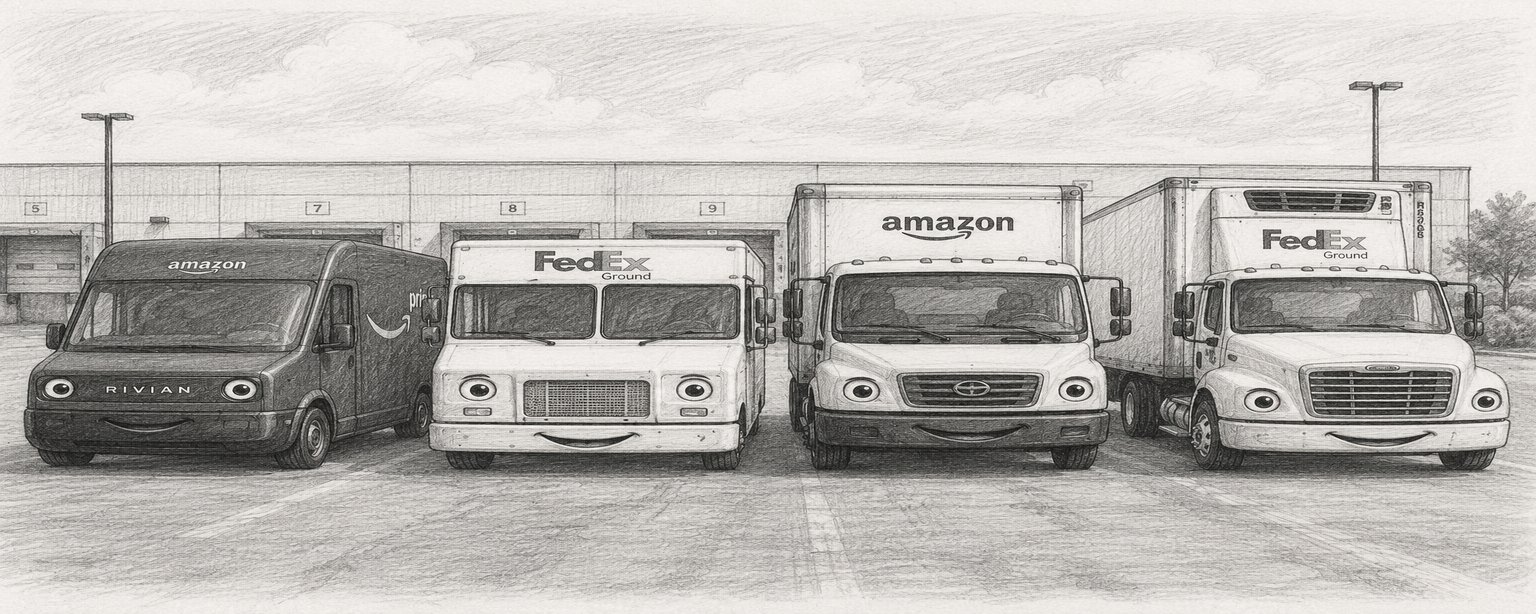
Amazon’s last-mile delivery program. DSPs operate 20-40 delivery vans out of Amazon delivery stations, delivering packages to residential and business customers. Drivers are W-2 employees (not independent contractors). Routes are assigned daily by Amazon.
Fleet & equipment
Amazon-branded vans leased through Amazon’s fleet program (~$500/month per van). Contractors do not own them – Amazon retains fleet control. Repair responsibility has been shifting to DSPs over time, including for the newer Rivian electric vans. Typical fleet: 20-40 vans. Light commercial class.
Why it matters
- Insurance: Fleet auto policy on leased vans + workers’ comp for W-2 employees. Amazon requires high liability limits. Low-speed residential routes mean lower accident severity.
- Lending: 100% Amazon-dependent revenue. Predictable contract terms but single-client concentration risk. Low capital requirements (vans are leased).
- Repair: Light commercial vans – Sprinter, ProMaster, Transit. High volume of stop-and-go driving. Routine maintenance: brakes, tires, oil changes at accelerated intervals.
Pickup and Delivery (P&D)
FedEx Ground
What they do
Pickup and Delivery for FedEx Ground – local freight transport within a metro area. P&D contractors pick up shipments from warehouses, distribution centers, or ports and deliver them to local businesses and residences. Often handles LTL (less-than-truckload) freight.
Fleet & equipment
Straight trucks, box trucks (Class 3-7), cargo vans, and occasionally day-cab tractors with 28-48 ft trailers. Equipment is typically contractor-owned. Liftgates and pallet jacks are common accessories.
Why it matters
- Insurance: General liability + motor truck cargo + auto liability. Multi-client operations mean diversified risk. Lower severity than long-haul due to shorter trips and lower speeds.
- Lending: Diversified client base = more stable than Amazon-exclusive contractors. Equipment financing is the primary loan product. Revenue is tied to local economic activity.
- Repair: Medium-duty trucks (Class 3-7). Liftgate maintenance, box/door repairs. Higher mileage than DSPs but less than linehaul. Local shops can handle most work.
Linehaul
FedEx Ground
What they do
Middle-mile transportation for FedEx Ground – moving freight between terminals, hubs, and distribution centers, not to end customers. Linehaul contractors run dedicated lanes, often hundreds of miles per trip.
Fleet & equipment
Class 8 tractors (sleeper or day cab) pulling 53 ft dry van or reefer trailers. Often owner-operator model – driver owns the tractor. Trailers may be provided by the shipper (power-only arrangement). High mileage: 100,000-150,000+ miles/year per truck.
Why it matters
- Insurance: Highest risk category. Long-haul highway miles = higher accident severity. Primary liability + motor truck cargo + physical damage on owned tractors. CSA scores directly affect premiums.
- Lending: High capital requirements – tractor purchase ($80K-$180K). Owner-operator model means personal credit is also relevant. Spot market exposure creates revenue volatility.
- Repair: Class 8 heavy-duty – engine overhauls, transmissions, DPF/emissions systems. Requires specialized diesel shops. High parts cost and downtime risk. PM schedules are critical.
Amazon Freight Partner (AFP)
Amazon
What they do
Amazon Freight Partner – Amazon’s middle-mile trucking program. AFPs haul full truckloads between Amazon facilities (fulfillment centers, sort centers, air hubs). Similar to linehaul but exclusively for Amazon and with Amazon’s safety and operational standards.
Fleet & equipment
Class 8 day-cab tractors pulling Amazon-branded 53 ft dry van trailers. AFP contractors own or lease their tractors; trailers are typically Amazon-provided. Fleet sizes range from 5 to 50+ tractors. CDL drivers are W-2 employees.
Why it matters
- Insurance: Similar to linehaul risk but Amazon imposes strict safety requirements and monitoring. Workers’ comp for W-2 CDL drivers + auto liability. Amazon’s safety culture can mean better loss ratios.
- Lending: Amazon-exclusive = concentration risk, but Amazon’s freight volume is enormous and growing. Tractor financing is primary need. Stable, predictable contract revenue.
- Repair: Same Class 8 heavy-duty profile as linehaul. Amazon may require specific maintenance standards. Day cabs (no sleeper) = simpler to maintain.
For-hire companies
What they do
Independent carriers that haul freight for multiple clients on the open market, rather than under a single program like Amazon DSP or FedEx Ground. The category now includes medical and pharmaceutical couriers, previously tracked separately, alongside appliance, furniture, and other retail last-mile work. They move everything from prescriptions and lab specimens to appliances and mattresses.
Fleet & equipment
Varies by commodity. Medical and pharmaceutical couriers run cargo vans, Sprinter vans, and small SUVs, often with temperature control and GPS tracking for chain of custody. Appliance and furniture carriers run box trucks, straight trucks, and liftgate-equipped vans. Most equipment is contractor-owned.
Why it matters
- Insurance: Multi-client exposure diversifies revenue, but risk tracks the commodity. Medical and pharmaceutical freight carries higher cargo value and regulatory stakes (HIPAA, chain of custody), so liability limits run higher. Appliance and furniture delivery adds cargo handling and residential property risk.
- Lending: More diversified than single-brand contractors. Financing needs follow the fleet – vans and box trucks for medical and retail, heavier trucks for furniture. An FMCSA USDOT number is a common underwriting signal.
- Repair: Light to medium duty. Stop-and-go metro routes wear brakes, tires, and suspension faster. Temperature-control units on medical vans are a specialty add-on.
Alternative Vehicle Program (AVP)
FedEx Ground
What they do
FedEx Ground’s supplemental delivery program for ISP contractors. AVP drivers use their personal vehicles to handle delivery volume spikes – not a replacement for salaried drivers in FedEx-branded vans. ISPs maintain a pool of on-call AVP drivers for days when package volume exceeds their regular fleet capacity. Drivers get a full day’s schedule of deliveries at once and are paid hourly, not per-package.
Fleet & equipment
AVP drivers use their own personal vehicles (cars, SUVs, minivans). The ISP enters a lease agreement with each driver for the use of their vehicle. The vehicle must display prominent FedEx Ground badging, matching the look of branded rental trucks. No commercial fleet to finance – the driver bears the vehicle cost. ISPs may need 30-40 AVP contacts to secure the 5 they need on any given day.
Why it matters
- Insurance: Critical gap: personal auto policies do not cover commercial package delivery. ISPs must ensure AVP drivers carry proper commercial coverage. The vehicle lease agreement between ISP and driver creates liability questions. Mixed fleet (commercial vans + personal vehicles) complicates underwriting.
- Lending: No fleet financing needed – AVP is purely a workforce model. The ISP’s capital is in their core van fleet. AVP reduces the need for spare truck purchases.
- Repair: Personal vehicles driven for commercial use wear faster (frequent stops, cargo weight). ISPs have no control over AVP vehicle maintenance. Breakdown risk sits with the individual driver, not the fleet manager.
Custom Critical
FedEx Ground
What they do
Expedited, time-sensitive, and high-value freight for FedEx Ground. Custom Critical contractors handle shipments that can’t fail – emergency parts for manufacturing lines, medical devices, aerospace components, trade show materials. 24/7 on-demand availability with guaranteed delivery windows.
Fleet & equipment
Sprinter vans, straight trucks with liftgates, and expedited straight trucks. Often equipped with air-ride suspension, temperature control, and real-time GPS tracking. Lower volume than linehaul but specialized handling. Owner-operators are common.
Why it matters
- Insurance: High cargo value limits – shipments can be worth $100K+. Tight delivery windows mean pressure to speed. Cargo insurance is a major line item. Fewer total miles but higher per-mile risk.
- Lending: Premium pricing = strong margins, but demand is volatile (tied to manufacturing emergencies, events). Lower capital needs (vans/straight trucks). Owner-operator heavy = personal credit matters.
- Repair: Medium-duty – Sprinter vans and straight trucks. Specialized equipment (liftgates, temp control) needs expert maintenance. Downtime is expensive – emergency repair response matters.
Local Commerce Service Partner (LCSP)
DoorDash
What they do
DoorDash’s program for local entrepreneurs to start their own delivery companies. LCSPs employ W-2 delivery associates (not 1099 gig workers) who fulfill orders through the DoorDash platform. The LCSP recruits, trains, and manages the delivery fleet, while orders – groceries, restaurant meals, flowers, retail items – come from DoorDash. This is a pilot program aimed at ensuring consistent delivery coverage for new order types.
Fleet & equipment
LCSPs provide their own delivery vehicles – typically cars, sedans, and small vans for local on-demand delivery. Not DoorDash-branded. Fleet size varies with order volume. Lower barrier to entry than DSP or linehaul operations since existing personal vehicles can be used. GPS tracking and DoorDash platform integration are the main technology requirements.
Why it matters
- Insurance: W-2 employee model means workers’ compensation insurance applies – unlike DoorDash’s core Dasher gig model. Commercial auto coverage needed for delivery vehicles. General liability for the LCSP business entity.
- Lending: Early-stage program with limited track record. Low capital requirements (no vehicle fleet purchase). Revenue tied to DoorDash order volume in the territory. Not exclusive – LCSPs can serve other platforms.
- Repair: Standard passenger vehicle maintenance (oil changes, brakes, tires). Higher frequency due to delivery duty cycles. No specialized equipment. Any local auto shop can service the fleet.
Owner Driver Franchise (ODF)
DPD UK
What they do
DPD’s UK contractor model – self-employed drivers run their own delivery franchise under the DPD brand. Owner Driver Franchisees (ODFs) provide collection and delivery services from DPD depots to homes and businesses, typically working 5 days a week. Two tiers exist: the standard ODF (full franchise) and ODF Lite. Drivers invoice weekly as independent contractors rather than receiving a salary. Routes are assigned by the local DPD depot.
Fleet & equipment
The driver provides their own van – must be DPD-approved (typically white with DPD livery applied). Vans are owner-financed, not provided by DPD. Requires hire-and-reward insurance, a full UK driving licence, and a DPD background check. Handheld scanner and DPD route app provided. Fleet size: typically 1 van per ODF, though some multi-van fleet operators exist.
Why it matters
- Insurance: Driver must carry their own hire-and-reward insurance (commercial vehicle use for paid deliveries). Goods-in-transit cover varies by contract and parcel value. Public liability coverage also required. DPD does not provide fleet insurance – this is the contractor’s responsibility.
- Lending: Single-van owner-operator model – individual credit profile is key. Van financing is the main capital requirement. Revenue is depot-dependent and seasonal (peak at Christmas). Limited recourse if route volume drops.
- Repair: Driver bears all vehicle maintenance costs. Light commercial vans (Transit, Sprinter, Master). High daily mileage and frequent stops mean accelerated wear on brakes, tyres, and suspension. DPD livery removal and reapplication adds cost at vehicle turnover.