

Amazon does not deliver most of its own packages. Two partner networks do the heavy lifting: thousands of independent delivery companies that handle the last mile to the customer’s door, and a smaller group of freight partners that move goods between Amazon facilities. As of August 2026, our database tracks 3,541 of these partners combined, and 3,401 of them operate across the United States.
These counts are a snapshot of our own database, not an official Amazon total. Amazon does not publish how many delivery partners it operates, and our list is not exhaustive, so the real figure is almost certainly higher. Treat these numbers as a floor rather than a precise total.
Here is how that network breaks down: where the partners are, how fast the network has grown, how old they are, how big a typical partner is, which Amazon stations they serve, and the other programs that sit alongside them.
Where Amazon’s delivery partners operate
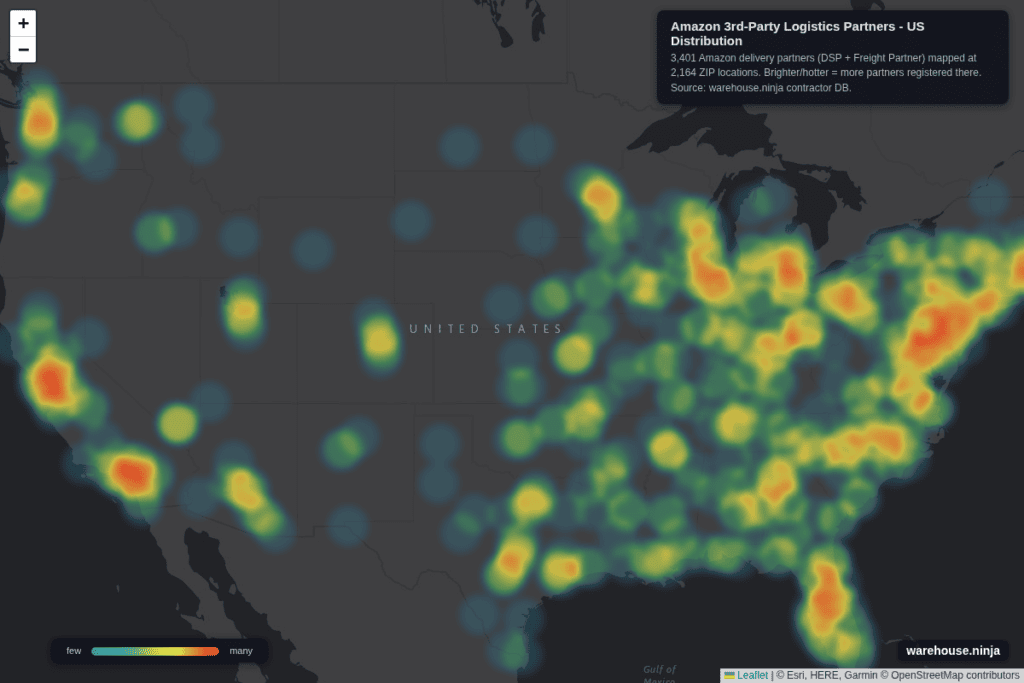
The partners are not spread evenly. The South is the clear leader, home to 38% of all US Amazon delivery partners, while the Northeast and Midwest trail behind.
- South: 1,293 partners (38%)
- West: 755 (22%)
- Northeast: 696 (20%)
- Midwest: 657 (19%)
At the state level, the top five are California (393), Florida (263), Texas (258), New York (200), and New Jersey (165). Those five states alone account for more than a third of the network. On the other end, Wyoming (1), Washington DC (2), Hawaii (3), Montana (4), and North Dakota (4) are the least covered.
How fast the network has grown
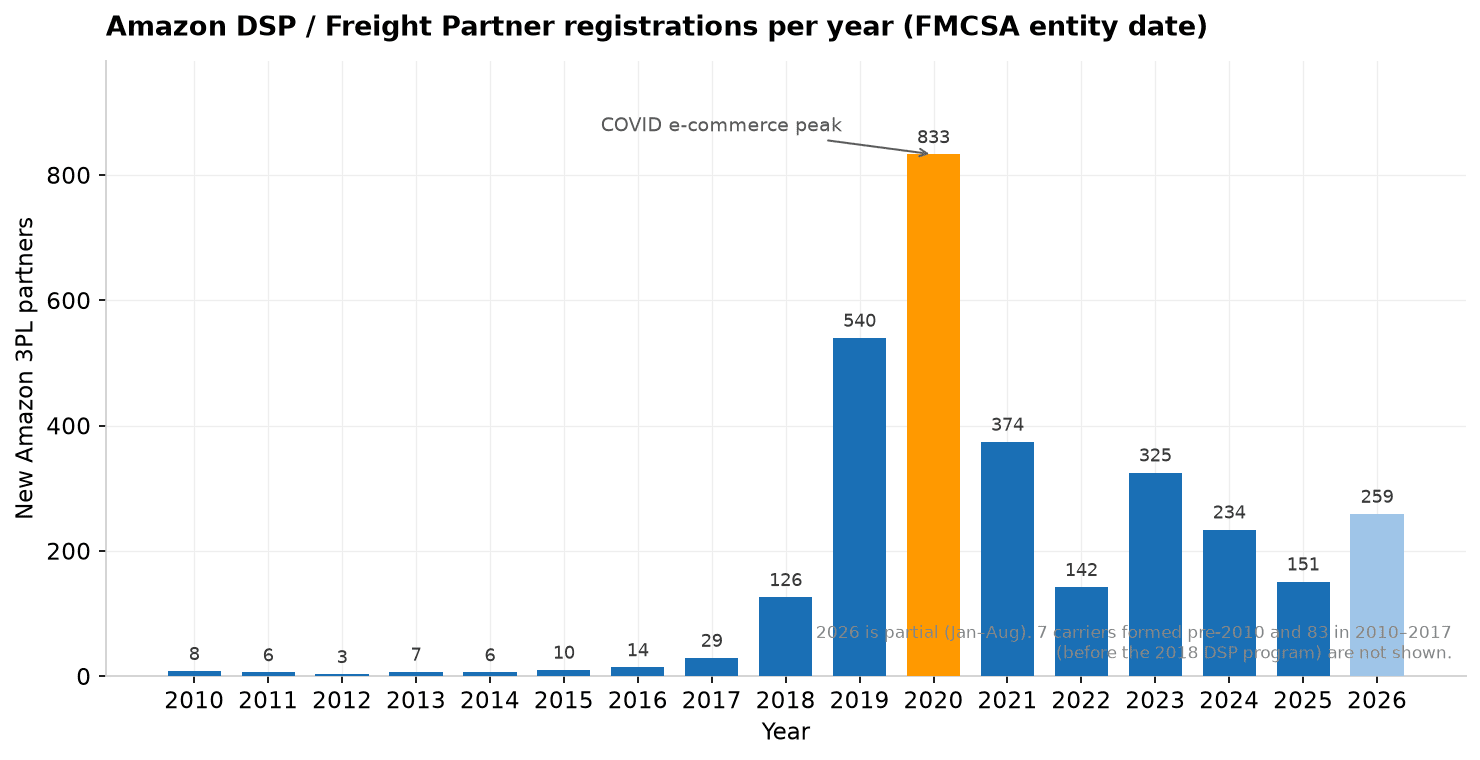
Amazon launched its Delivery Service Partner program in 2018, and the growth curve since then tracks the pandemic-era e-commerce boom.
These are not official figures. They reflect only what we have mapped in our data, and the real totals are likely higher, since carriers appear in the FMCSA registry on their own schedule.
- 2018: 126 new partners
- 2019: 540
- 2020: 833 (the peak)
- 2021: 374
- 2022: 142
- 2023: 325
- 2024: 234
- 2025: 151
- 2026: 259 (through August)
The 2020 spike stands out: 833 new partners registered in a single year as online ordering surged. The next two years cooled off sharply, bottoming out at 142 in 2022, before rebounding to 325 in 2023.
How old are these companies?
Most Amazon delivery partners are young. Three quarters of the partners with a date on file were formed in 2020 or later, matching the pandemic-era surge in the network.
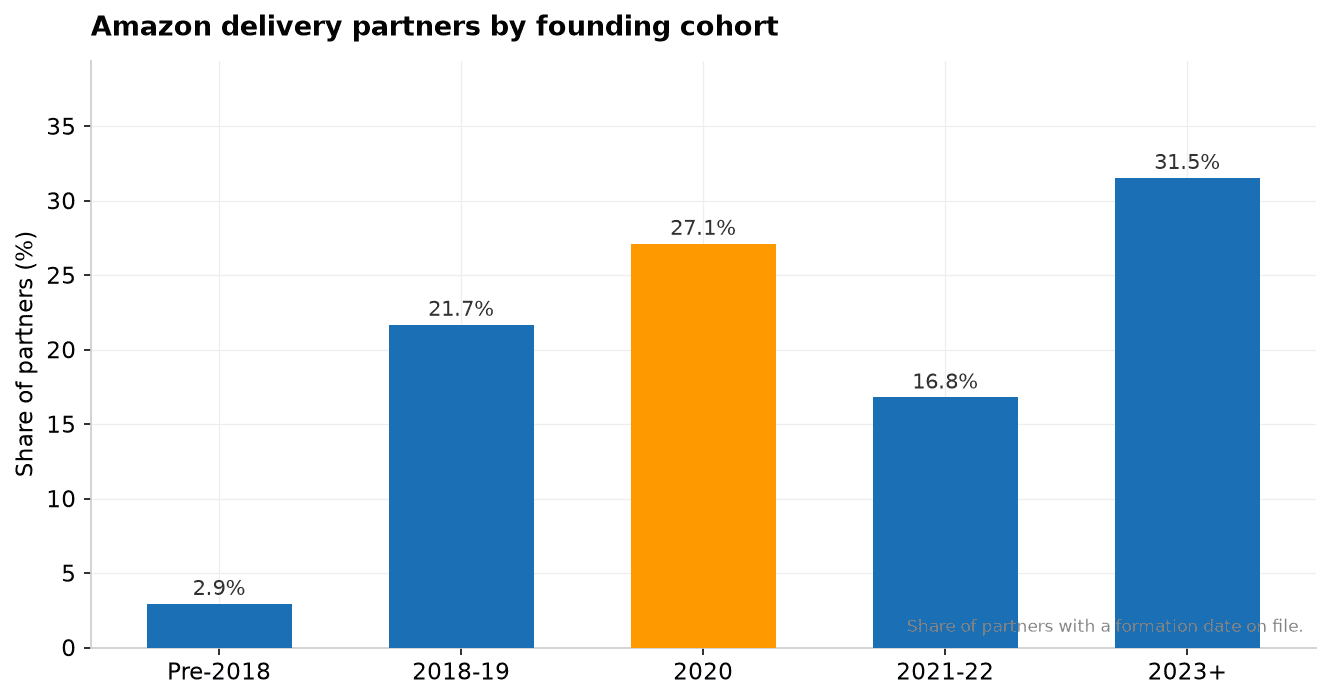
A small share predate Amazon’s 2018 DSP launch. These are older logistics companies that later added Amazon delivery work, and a few have been operating for decades.
The newest group is still growing: more partners have registered so far this year than in all of last year.
One caveat: 13% of partners have no formation date on file, so these age figures apply only to the dated set.
How big is a typical partner?
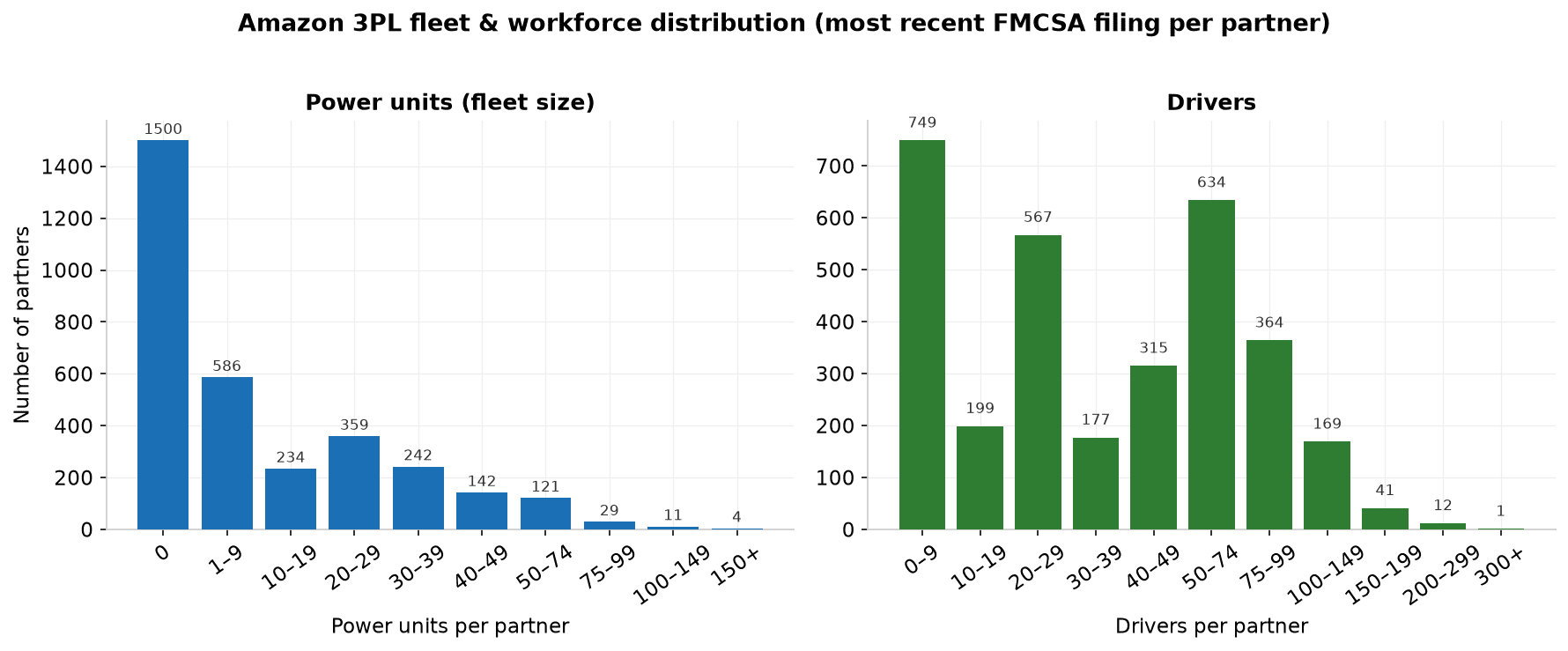
Most Amazon delivery partners are small businesses. The median partner reports 33 drivers. A quarter report 60 or more, and the top 10% report 90 or more.
Fleet size is harder to read. The median partner lists just 1 power unit (a truck or van), and roughly 46% list zero. That reflects how the DSP model works: partners lease most of their vehicles from Amazon rather than owning them, so the owned fleet stays small even when the operation is large. Driver count is a better gauge of scale.
Which Amazon stations are busiest
Amazon’s delivery partners are attached to specific delivery stations. Our data maps 766 Amazon locations, and 743 of them have at least one partner attached.
Most stations are served by a small handful of partners. There are 227 stations with a single partner, 144 with two, and 115 with three. Only a few reach double digits.
- DGE9 (Buford, GA): 14 partners
- DPA7/DHO3 (Houston, TX): 14 partners
- DHO8 (Houston, TX): 13 partners
- A station in Durham, NC: 13 partners
- MSP7 (Maple Grove, MN): 10 partners
The other Amazon partner programs
Delivery Service Partners and Freight Partners are not the only ways Amazon fills its network. A few other programs sit alongside them.
Amazon Flex is the gig version of last-mile delivery. Individual drivers sign up, use their own car, and deliver packages shift by shift. Flex drivers are individuals rather than companies, so they do not show up in a carrier registry the way DSPs do.
Amazon Hub Delivery is Amazon’s newest last-mile model. It lets small local businesses such as coffee shops, laundromats, and florists deliver a small batch of packages in their own neighborhood using an existing vehicle and staff. Amazon runs the routing in an app, and the pitch to businesses is low-investment extra income during slow hours. It is a far lower bar than the DSP program, which asks owners to stand up a fleet of branded vans. Amazon describes the program on its Hub Delivery Partner page.
Amazon Relay is the middle-mile counterpart. It is a free load board where trucking companies and owner-operators book Amazon freight between fulfillment centers, sort centers, and delivery stations. Carriers need a DOT number and commercial insurance, and Amazon supplies the trip details with no broker in between. Details are on the Amazon Relay site.
Freight Partners are the branded version of that middle-mile work, running Amazon-branded trucks on the same lanes. Our 235 Freight Partners sit inside the 3,541 count above. Flex drivers, Hub Delivery partners, and independent Relay carriers are not part of that number.
The programs also differ in how exclusive they are. Flex, Hub Delivery, and Relay are open arrangements: a driver or business can work with Amazon one day and another company the next, and Relay carriers routinely book loads from other shippers. Delivery Service Partners and Freight Partners sit at the other end. DSPs hold an exclusive contract with Amazon-branded vans and uniforms, and Freight Partners run Amazon-branded trucks dedicated to Amazon lanes. Picture it as a spectrum: the gig and marketplace programs treat Amazon as one client among many, while the DSP and Freight programs ask the owner to become an Amazon operator.
A note on what counts as an Amazon partner
This analysis counts two types of Amazon contractors: 3,306 Delivery Service Partners and 235 Amazon Freight Partners. We excluded 36 partners marked closed in our database, and we counted the 50 states plus Washington DC, which leaves out 140 records located mostly in the UK and Canada.
The underlying source is the FMCSA carrier registry, which is why the fleet numbers skew low: what a carrier reports to the federal government as owned equipment is not the same as what it leases from Amazon day to day.
Our coverage is not complete, either. Carriers appear in the FMCSA registry on their own schedule, and partners open and close constantly, so these totals reflect what we track at a point in time rather than Amazon’s precise number.


